* (Cover photo: 1959 FORD Thunderbird Convertible in Drive-in Cinema).
=> "Drive-in Cinema" resurfaces as an entertainment alternative in a pandemic time.
"THE VENTURES are considered the most influential, best-selling Instrumental Band in ROCK AND ROLL history.
Over 450 (LPs and CDs including compilations) Released Worldwide."

"THE VENTURES have written over 1000 tunes, and recorded over 3000 songs altogether! If they ever decide to play all of the songs that they've ever recorded, it would take almost 5 days - without a break - to play them all."

"While they predated the advent of the terms surf guitar and surf rock, and they do not consider themselves a surf music group, they were a major building block of instrumental guitar-driven music. "Guitar Player", in an article titled "20 Essential Rock Albums", cited elements of their 1960 "Walk, Don't Run - Album" (Dolton Records BLP-2003 (mono) / BST-8003 (stereo)) which presaged the coming surf trend."

"Most instrumental groups of the 1950s and '60s disappeared after one hit, but the longevity of The Ventures, the best-selling instrumental group of all time, demonstrated the enduring appeal of the genre as well as the band's skill in choosing recording material."

"It was the electric guitars that made the impression; that and the unique rhythmic pulse that Wilson and Bogle had developed in 1958 in Tacoma, Washington, when they tried to make up for the fact that they didn't know any drummers, let alone pianists or sax players. At the time, most record companies wouldn't look at you if you had neither.
- "I played a very percussive rhythm-guitar style", Wilson says: "And Bob used to play with the whammy bar, and once in a white instead of a note he'd hit a chord and give it a little vibrato".
But the most distinctive element of The Ventures sound was that damped, rapidly picked descending glissando, which Japanese call "deke-deke-deke"."

"Through the nuances and characteristics of "THE VENTURES STYLE" in the songs, we can distinguish the unique songs played by them.
This is the "VENTURIZED SOUND". Enjoy !"

Get Venturized !!!

The sound of this website will be better appreciated with High Fidelity Stereo Headphones.

"The Ventures: Stars On Guitars" (Promo)

- New promo video for “The Ventures: Stars on Guitars” documentary, out 12/08/2020 ����❣️ @Staci Layne Wilson
- Please share with anyone you know who loves music ��

https://youtu.be/CnyyFtLYdNI

Coming soon to VOD and DVD- The Ventures: Stars on Guitars!

"The Ventures are one of the most influential guitar-based bands of their era.” — Rolling Stone

The Ventures have been thrilling music lovers with songs like “Wipe Out,” “Walk Don’t Run,” and “Hawaii 5-0” for over half a century. Started by Don Wilson and Bob Bogle in 1959, the band went from humble beginnings in Tacoma, WA., to worldwide acclaim, culminating as inductees into the prestigious Rock and Roll Hall of Fame as the #1 Bestselling Instrumental Rock and Roll Group of all time.

Now, see the story of the world’s most famous instrumental rock and roll band from those who know them the best: movie stars like Billy Bob Thornton, music legends such as Jimmy Page (Led Zeppelin), Jeff “Skunk” Baxter (Steely Dan), The Surfragettes, Lalo Schifrin (Academy Award winning composer of The Mission Impossible theme), Randy Bachman (Bachman-Turner Overdrive), and John Fogerty (Creedence Clearwater Revival), and their family. Witness the rise and influence of the electric guitar, the history, and the relevance of the band in pop culture still today, while you rock out to the stellar soundtrack. @Vision Films

* Soundtrack: "Holy Surf!" (M.Trapp) - The Alien Mike E.T. (2020)

Friday, February 5, 2021

"Manhã de Carnaval" - Black Orpheus movie theme Song

Note: Click highlighted words to access external link for details.

Nokie Edwards playing "Manhã de Carnaval" (Luiz Bonfá), the theme from Black Orpheus movie (Orfeu Negro-1959). Franc-Brazilian-Italian film based on the play "Orfeu da Conceição" by Marcus "Vinicius de Moraes"
Black Orpheus won the Palme d'Or at the 1959 Cannes Film Festival, the 1960 Academy Award (the Oscars) for Best Foreign Language Film, the 1960 Golden Globe Award for Best Foreign Film and the 1961 BAFTA Award for Best Foreign Language Film. 

*(Nokie Edwards - Lead Guitar, DON Kiyohara - Rhythm Guitar (from Edo Yamaguchi - Tokyo Ventures), BOB Hattori - Bass Guitar, M. Tadano - Drums) - November 13, 2006 - Nishi Kawaguchi "Hachi no Musashi" 

Black Orpheus (Manhã de Carnaval) Nokie Edwardsノーキー・エドワース / 黒いオルフェ
 

 ooo0O0ooo

Black Orpheus and the film in Portuguese (and about Brazil) that won an Oscar for France

Marcel Camus film still has the iconic song "Manhã de Carnaval" on its soundtrack 

By Felipe Ernani --- 11/02/2020
Tenho Mais Discos que Amigos!

In 1959 the French director Marcel Camus launched his masterpiece. Orfeu Negro dealt with themes related to Brazil and, therefore, it was filmed in our lands and starred by Brazilian actor and soccer player Breno Mello - even though he played opposite Marpessa Dawn , a French woman born in the United States.

The feature was based on the play Orfeu da Conceição , by Vinícius de Moraes , which in turn was a reinterpretation of the mythological history of Orpheus and Eurydice within the context of Rio de Janeiro, during Carnival. Replacing the lyre with a guitar, the story full of magic and emotion was acclaimed around the world.
 
The importance of Black Orpheus and an incredible soundtrack
 
The influence of Vinícius' work was translated beyond the images. The soundtrack captured the essence of Rio and generated two of the most beautiful songs in Brazilian cinema, “A Felicidade” (by Tom Jobim ) and “Manhã de Carnaval”, by Luiz Bonfá , which is the fifth most recorded song in history in Brazil .
 
However, the impact went beyond our lands. American artist Jean-Michel Basquiat cited Orpheus Black as one of his first inspirations; former US President Barack Obama also said the film was his mother's favorite. But he did not share his tastes, saying:
 
"I suddenly realized that the portrayal of the childish blacks I was seeing on the screen, the reverse image of [Joseph] Conrad's wild blacks, was what my mother had carried with her to Hawaii all those years before. A reflection of the simple fantasies that were forbidden to a middle-class white girl from Kansas, the promise of another life: hot, sensual, exotic, different."
 
1960 Oscar Award

The worldwide success earned the film an Oscar nomination the following year for Best Foreign Film. The point is that the award classified the film, which was co-produced by France, Brazil and Italy, as only French.
 
And the negative repercussion of this decision became even greater when Orfeu Negro was announced as the winner of the category: a film in Portuguese, recorded in Brazil, filmed in Brazil and with a leading Brazilian actor was awarded as a French production.


Luiz Bonfá : "Manha De Carnaval" / Scene Du Lever Du Soleil

ooo0O0ooo

The story of "Orfeu Negro", Oscar for best foreign film in 1960 - 02/26/2016 - Jornal Futura - Canal Futura 

Many Brazilians are unaware, but the Oscar for best 1960 foreign film was awarded to an French-Brazilian-Italian production: "Orfeu negro" or "Orfeu do Carnaval", in which all the actors were black, directed by French man Marcel Camus. 

The script was based on a play by Vinicius de Moraes, "Orfeu da Conceição" (Orpheus of the Conception), which adapted the Greek myth of Orpheus and Eurydice to Carnival and the hills of Rio de Janeiro and had the scenographic contribution of Oscar Niemeyer, in addition to having a cast entirely formed by black actors, a novelty at the time.


In Greek myth, Orpheus is an exceptional musician and poet, who touches even the beasts with his art. He follows the beloved even after her death. 

Filmed in Rio de Janeiro and spoken in Portuguese, Orpheus featured Brazilian artists, with a single exception, the protagonist, the American actress Marpessa Dawn, the wife of director Marcel Camus.

To form the cast, the director counted on the help of the newspaper "O Globo", which held a contest with the participation of more than a thousand candidates. The bi-champion triple jump olympic champion, Adhemar Ferreira da Silva, participated as an actor in both the play and the film. And then soccer player Breno Mello played Orpheus in the cinema.

One of the highlights of the film is the soundtrack composed by Tom Jobim, Luís Bonfá, Vinicius de Moraes and Antônio Maria, four of the most important Brazilian composers of the time.
 
Many researchers and music critics consider Orpheus' soundtrack to be a kind of ground zero for bossa nova.
 
Em 1960, "Orfeu Negro" ganhou o Oscar de melhor filme estrangeiro - Jornal Futura - Canal Futura (Spoken in Portuguese)

(from left to right) Luiz Bonfá, Marcel Camus, President of Brazil Juscelino Kubitschek de Oliveira, Lourdes de Oliveira, Breno Mello and Vinicius de Moraes, 1959,

Orfeu Negro (Black Orpheus) - 1959 - Full Movie (1h47m43s) (Dubbed in English)

Thursday, December 10, 2020

New Doc "The Ventures: Stars on Guitars" Tells Story of Best-Selling Instrumental Band of All Time


"PEOPLE magazine, new interview with Don Wilson!"

PEOPLE.COM > MUSIC 
People EXCLUSIVE

“It means so much to me that my kids made this," former Ventures guitarist Don Wilson, 87, tells PEOPLE 

By Scott Huver - December 08, 2020 05:35 PM

The pioneering surf-rock band The Ventures have been an iconic presence in music and pop culture for 60 years, from their breakout hit "Walk Don't Run" to the enduring theme song to Hawaii 5-O to the soundtrack of Pulp Fiction. But the band's backstory has never been told on film until now – and it took one of the original members' children to make it come together. 

The new documentary, The Ventures: Stars on Guitars, is available now on streaming and home video, telling the tale of the wildly influential group's rich and impactful status as the best-selling instrumental band of all time, having recorded more than 250 albums and over 3,000 songs. Behind the scenes, the lively tour through the band's long history was assembled by the children of the group's co-founder and sole surviving original member, guitarist Don Wilson. 

"This is the first actual documentary about The Ventures, if you can believe," Wilson, 87, who retired from touring with the group just five years ago, tells PEOPLE via email. "It means so much to me that my kids made this." His son Tim Wilson and daughter Jill Fairbanks served as producers, and his daughter Staci Layne Wilson wrote and directed the film. "They all worked together and interviewed me over three different sessions to get my memories and thoughts on things. It was really great." 

The Ventures
| CREDIT: COURTESY STACI WILSON

"I find it baffling that over the 60-year career that this is really the first feature-length documentary," said Staci, an award-winning indie horror filmmaker and longtime entertainment journalist. "There's been a few concert films released and things, but nothing like this. So my dad is just really grateful that myself and my siblings came together to make this happen, and I'm so grateful that he's still here to see it." 

Staci (whose late mother, model and writer Nancy "Bunny" Bacon appeared on the cover of the group's 1964 album Walk Don't Run, Vol. 2) tells PEOPLE that after a few well-intentioned efforts by others to put together a documentary failed to come together over the years. Finally, the family realized they could probably make it happen on their own. "My brother said, 'Well, you're a filmmaker – maybe you can do this.' But actually a documentary is so much different to make than a narrative film. I knew it would be difficult, but I didn't know exactly what I was getting myself into! But three years later, here we are." 

"She really did a great job. I think the documentary really lays it out exactly as I would have, if I made movies instead of music," says Don. "It's really something else to see 60 years condensed into an hour and half!" 

Among the many facets of The Ventures that the film chronicles is how the band's distinctive sound was immediately embraced by the youthful 1960s-era surf cultures of Southern California and Hawaii, and its many electric guitar-driven hits – including "Pipeline," "Wipeout" and "Pefidia" – remain anthemic for surfers and beach partiers around the globe today. 

"We never set out to be a surf band," marvels Don. "Honestly, I love playing surf music – it's very fun and it makes you feel good. But we never really considered ourselves a surf band. It was just all these things coming together – the surf culture, the electric guitar, Americana – when we were coming up in the early 1960s. Kind of a happy accident, I guess you could say. We play all kinds of music, though, including our "Venturizing" of everything from classical to disco." 

The Ventures' history is filled with unique distinctions: the group became and remain today one of the most popular international acts among Japanese fans, and every decade or so the band, which toured non-stop between 1960 and 2015, would receive a boost from another pop cultural juggernaut that renewed its relevancy kept it in the spotlight – recording the Hawaii 5-O theme in the 1970s, collaborating on "Surfing and Spying" with The Go-Go's in the 1980s, Quentin Tarantino, who learned guitar from their songs in his youth, including "Surf Rider" in the top-selling soundtrack of Pulp Fiction. John Belushi so loved the song "The 2000 Pound Bee" that Dan Aykroyd lived up to a pact and had it played at his funeral. 

Credited with having an integral role in popularizing the then-revolutionary electric guitar among multiple generations of musicians – from phenomenally successful artists to amateur garage bands – The Ventures' legacy is celebrated in the film by a variety of artists to testify to their powerful impact, including Creedence Clearwater Revival's John Fogerty, Steely Dan's Jeff "Skunk" Baxter and The Ramones' Marky Ramone, as well as left-of-center admirers like actor/musician Billy Bob Thornton, Alabama's Jeff Cook, Anthrax's Scott Ian and Mission: Impossible theme composer Lalo Schrifin. 

"I have to say, it was really something to see what other musicians have to say about me and my bandmates," said Don, who even after all these years is stunned when he finds out who’s a big fan of the Ventures. "When were inducted into the Rock & Roll Hall of Fame, Billy Joel came up to say congratulations and to say thank you for being an influence on his piano playing. At one point, Elton John said the same thing, so, while guitar-players being influenced by us is kind of expected, there are lots of other kinds of musicians, too…That is really, really humbling." 

Staci's background as an entertainment reporter came in particularly handy when assembling the all-star roster of fans. Years earlier she filmed a red carpet interview with Led Zeppelin's Jimmy Page in which they veered into a chat about her father's music. "Luckily I had kept that because I'm a huge Jimmy Page fan. I just kind of kept it to myself. Then as it turned out, I was able to use it for this documentary that wasn't even a glint in my eye at the time." 

Similarly, she was well aware of Thornton's passionate fandom – he even recorded an unreleased album with the group – and had previously put him in touch with her father. Later, when she had an unexpected encounter with Thornton at a recent Hollywood event, "I just said, 'Hey, you want to be in the documentary?' And he goes, 'Oh yeah, set it up with my manager!' The next thing you knew, there he was in front of the camera." 

Both Don and Staci admit that the documentary had strengthened their already-tight bond. "We've always been close, but we didn't talk about The Ventures and my career as much as we have in the past few years," says Don. "It's nice that my kids are honoring me this way." 

"When it's your dad, it's just something you see every day, and you take it for granted," says Staci. "Being able to interview him extensively in a different capacity not just as a daughter but as a filmmaker was really fun and interesting, to listen to his stories from a more objective point of view rather than just my dad telling his stories about his life. I had a lot of fun and asked him a lot of questions that I probably wouldn't ordinarily have asked him if I weren't making the film." 

"I've been into more hard rock like led Zeppelin and the Who and the Rolling Stones," she adds. "So it really made me appreciate the fact that if it weren't for The Ventures, a lot of the bands that I love may never have existed – or at least not in the way that they do…Hearing it come from someone other than my dad, like all the musicians that I interviewed, it really was an eye-opener, and it really made me have a newfound respect for The Ventures and what they did for the electric guitar." 

Although he no longer tours, Don still plays in the studio with the modern lineup of The Ventures. And he misses his original bandmates. "Bob Bogle, who started The Ventures with me, was like a brother to me. They all were – Mel Taylor, Nokie Edwards, Gerry McGee. They're all gone now, but we will always have that bond. Forever." 

"Also, the loyalty and love of the fans, many of whom have stuck with us since our very first album in 1960, is amazing," he adds. "They are just so close to my heart. I have kept a lot of their letters, because it means so much to me that we have meant something to them." 

The Ventures: Stars On Guitars is available for rental or purchase from most prominent VOD retailers and cable services, and well as on DVD. 

Link to the article published on People.com: 

Friday, October 23, 2020

"Moon Of Manakoora" Song (1961)

"The Moon of Manakoora" is a popular song written by Frank Loesser (lyrics) and Alfred Newman (music) for the 1937 Paramount film "The Hurricane" starring Dorothy Lamour. Lamour made a commercial recording of it. The song "The Moon of Manakoora" is considered a standard and was Loesser's first success as a lyric writer. 

Manakoora, loosely translated to English, is "witchcraft", derived from "mana" meaning "magic" and "koora/kura" (pronounced "KUU-rah") meaning "lore" or "school" or "body of knowledge". 

The song has been covered by many other artists, including: Chet Atkins, Gene Krupa, Bing Crosby, Percy Faith,  Henry Mancini, Les Paul & Mary Ford and The Ventures. It is also a popular song in the hawaiian dance repertoire.

The stunningly beautiful version of The Ventures was recorded on the 2nd Album "The Ventures"  (Dolton BST-8004 / BLP-2004) (June 1961). Producer Bob Reisdorff & Josie Wilson. With Bob Bogle and Don Wilson on guitar, Nokie Edwards on bass and Howie Johnson on drums. There are claims that it was Nokie Edwards who played the lead guitar but he never claimed it. At this time Fender guitars were used.

"The Hurricane" 1937 movie poster

This song "The Moon Of Manakoora" (The Ventures) after watching the movie, takes us back to scenes and deep feeling in the music.

"The Hurricane" (film):
The Hurricane is a 1937 film set in the South Seas, directed by John Ford and produced by Samuel Goldwyn Productions, about a Polynesian who is unjustly imprisoned. The climax features a special effects hurricane. It stars Dorothy Lamour and Jon Hall, with Mary Astor, C. Aubrey Smith, Thomas Mitchell, Raymond Massey, John Carradine, and Jerome Cowan. James Norman Hall, Jon Hall's uncle, co-wrote the novel of the same name on which The Hurricane is based.


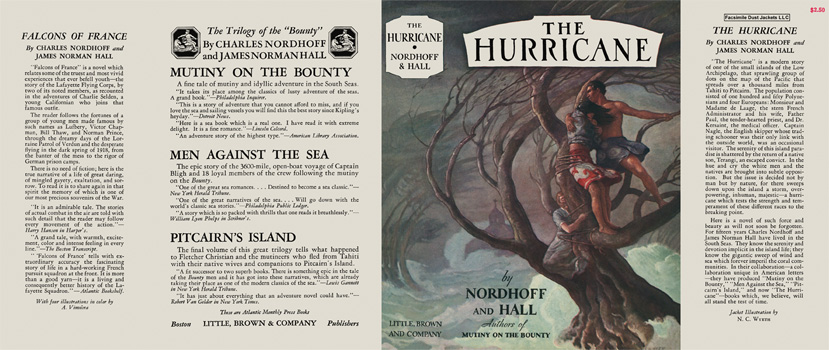
based in "The Hurricane" novel (1936)
Nordhoff, Charles and Hall, James Norman
Storyline:
In the Island of Manakoora, a French colony in the South Seas, the joyful Terangi is a leader among the natives and the first mate of the Katopua, the tall ship of Captain Nagle. Terangi gets married with Marama and sooner he sails to Tahiti. While in a bar playing with other natives, Terangi is offended by an alcoholic and he hits his face, breaking his jaw. Despite the testimony of Captain Nagle, Terangi is sentenced to six months of forced labor since the victim had political connections with the Powers That Be. Captain Nagle asks the Governor Eugene DeLaage to uses his influence to help Terangi, but the governor refuses. Terangi unsuccessfully tries to escape from the prison, and each attempt increases his sentence. Eight years later, he finally escapes and his jailbreak is celebrated in Manakoora. Father Paul finds his canoe and brings Terangi to the island. But a devastating hurricane also arrives in the island threatening the dwellers.

MARAMA (Dorothy Lamour) & TERANGI (Jon Hall)

TERANGI (Jon Hall), MARAMA (Dorothy Lamour) and TITA (Kuulei De Clercq)

Awards and nominations:
The film was nominated for three Academy Awards (1938 The Oscar), winning in the category for Best Sound.
*Best Sound Recording - Thomas T. Moulton
*Best Supporting Actor (nomination) - Thomas Mitchell
*Best Music, Score (nomination) - Alfred Newman

"The Hurricane" (1937) - Movie Trailer

Dorothy Lamour - "The Moon Of Manakoora" (1937)

The Ventures - "The Moon Of Manakoora" (1961)

"The Hurricane" (1937)  full movie  (1h43m24s)

Friday, October 2, 2020

The Story of Joe Bailon, creator of Candy Apple Red

Updated on February 13, 2022

The beautiful color used in The Ventures guitars

In 1963 The Ventures saw the business opportunity with the Mosrite guitars they used and thus the "The Ventures Model" was born. At the time the predominant color was Sunburst and other colors were Candy Apple Red, Pearl White and Candy Apple Blue.

Bill Gruggett in an interview with  japanese publisher said he used bronze powder to make the golden effect of the paint base.

Don Wilson in 1963, when he toured in Japan, took a Mosrite guitar in "Candy Apple Red" while Nokie Edwards and Bob Bogle in "Sunburst". 

This Don Wilson guitar was delivered to The Beatniks band in Japan. And this guitar didn't have a serial number and metal guitar nut. Another feature of  the 1963 model is that it has only three screws that hold the pick guard and jack input on the side.

Currently the owner of this guitar is the japanese collector Mr. Teruhisa Kitahara that keep in playable condition.

"Candy Apple Red" is one of the beautiful colors appreciated by Don Wilson and The Ventures. 

Below is the guitar that was displayed at the Kyobashi EdoGrand in Ginza, Tokyo and the video of the guitar with the owner.

1963 Mosrite Guitar - Don Wilson (Kyobashi EdoGrand, Ginza, Tokyo - Japan) @koru2258koru


The Ventures In Japan (1965) - Liberty LR-7270 album cover, with Don Wilson holding this guitar.

The Ventures Knock Me Out (1965) - Liberty LR-7200

ooo0O0ooo

The Story of Joe Bailon, creator of Candy Apple Red

"Miss Elegance" 1941 Chevrolet Kustom by Joe Bailon

Date: October 2, 2017
Author: Jesus R. Garcia
JESUS BEHIND THE WHEEL
News & Articles

Joe Bailon, The Creator of Candy Apple Red

I must admit that I did not know who Joe Bailon was until it was too late. When I read that he had passed away, at the age of 94 on September 25th, I felt bad that I didn’t get to appreciate his work while he was still alive. Especially after I read his about his life’s work and found out that he was the man who invented Candy Apple Red. A color that took 10 years to perfect!

Paint it Red, Origins of Candy Apple Red

You be hard pressed to find a vehicle that didn’t look good in a shade of red. From arrest me red, fire engine red, Ferrari red, but the one that people know the most is Candy Apple red. Even if they don’t know exactly what it looks like they know that with a name like that it’s going to looks gorgeous.


The process is easier said than done. You need to apply a layer of gold paint first. Then add red paint over it, and finally a layer of clear coat. The trick is to mix red paint with the clear coat to get that rich saturated red that looks good enough to eat. Bailon’s paint jobs were famous for looking like ultra-smooth and thick enough to cut with a knife before hitting bare metal. 

Inspiration for Candy Apple red, according to the American Hot Rod Foundation, came from Bailon’s fascination with how taillights looked at night in the rain. That rich shade of red that made him think about how an entire car would look in that color. Story goes that he was driving one night and noticed the taillights in the car in front of him. Glowing in the night. That image was burned into his brain and for the next 10 years he set to recreate that color by mixing countless paint combinations in his shop. 

It wasn’t until 1956 that he finally got it right. He sprayed a layer of gold and chased it with a shade of extra-brilliant maroon and topped it off with clear lacquer. The rest is Kustom history.

( ... )

A Pioneer in Automotive Art

Joe Bailon will live on in the imagination of anyone who wants to see their vehicle in a rich candy color. Regardless if it’s a wrap or a full paint job. What I admire about Bailon, and car builders of that era, is their genius for detail. I can’t imagine how long it would take me to build a car the way they did. The imagination and skill involved is nothing short of amazing and should be recognized and admired for generations to come. 

Thank you Joe Bailon for inspiring those after you and giving us the technique to create one killer paint job. May you forever rest in peace.

Full article at this link:

https://jesusbehindthewheel.com/2017/10/02/joe-bailon-creator-candy-apple-red/#comments

Source consulted in Japanese: "Vintage Mosrite", Shinko Music Mook (Magazine+book) (Aug. 10, 2000 edition)

ooo0O0ooo

(@drolivas1 - YouTube channel)

On 6-13-2012 Joe Bailon talks about the day his hand was casted for the Motorama Wall of Legends display in Long Beach, California, Correction in video: Autorama was mentioned in error, the correct reference is "Motorama."

ooo0O0ooo

More article about Joe Bailon "Miss Elegance":

Custom Car Chronicle
September 26, 2017 by Rik Hoving


Tuesday, April 21, 2020

"Caravan" Song (1961)

"CARAVAN" song is a "Big Band Jazz" song composed by Juan Tizol and Duke Ellington. And the lyrics by Irving Mills. And it was recorded in 1936 with Duke Ellington (piano), Juan Tizol (trombone), Cootie Williams (trumpet), Barney Bigard (clarinet), Harry Carney (baritone sax), Billy Taylor (bass) and Sonny Greer (drums).


It is a famous song that THE VENTURES play in the final "encore" of concert performances.

There are two versions of this song recorded by The Ventures. The first version was recorded on their first Album "Walk Don't Run", released in November 1960. Producer: Bob Reisdorff. With Bob Bogle as the lead guitarist using a Fender Jazzmaster Guitar, Don Wilson as rhythm guitar, Nokie Edwards with bass guitar and Howie Johnson on drums.


The second and current version was a version that played in shows and was recorded on the 11th Album of the group "Bobby Vee Meets The Ventures" in April 1963. Producer: Bob Reisdorff & Snuff Garrett. This with Nokie Edwards as lead guitarist and using techniques from his idol Les Paul. And playing with a Mosrite Guitar. But recorded without the drums evolution part.

Check out the Caravan of Juan Tizol and Duke Ellington and their Orchestra, the first version of The Ventures and finally the classic and well known version of The Ventures.
Enjoy the phenomenal performance of drummer Mel Taylor.

"CARAVAN" - JUAN TIZOL & DUKE ELLINGTON AND HIS ORCHESTRA (1952)


"CARAVAN" - THE VENTURES - 1960 (FIRST VERSION OF THE VENTURES with Jazzmaster)
Bob Bogle (lead guitar), Don Wilson (guitar),  Nokie Edwards (bass) and Howie Johnson (drums)


"CARAVAN" - THE VENTURES (SECOND VERSION AND LATEST with Mosrite)
Nokie Edwards (lead guitar), Don Wilson (rhythm guitar), Bob Bogle (bass) and Mel Taylor (drums)

Saturday, April 18, 2020

The Ventures: still rocking after 50 years

MUSIC
The Japan Times
Article History
"The Ventures: still rocking after 50 years"
By Philip Brasor
AUG 7, 2008

Link of article in "The Japan Times":
https://www.japantimes.co.jp/culture/2008/08/07/music/the-ventures-still-rocking-after-50-years/#.XptS7NT0lHY

The Ventures have just finished playing 33 songs in the space of two hours in front of some enthusiastic, though seated, middle-aged fans at the Hokutopia concert hall in Tokyo. Kazushi Kojima, who calls himself a “philosopher,” is there with his son. He’s been attending Ventures shows for 30 years.

“My parents listened to The Ventures,” he says. “My first musical hero was Tom Jones and later I was into British rock — Led Zeppelin, that sort of thing.” Eventually, he gravitated back to The Ventures. “I’m really into martial arts and jazz, and I make sure my son listens to everything.” The son nods sheepishly. Asked if he likes The Ventures, too, he says, “I borrowed some CDs from my father. I was impressed.”

“The Beatles were always overrated in Japan,” Kojima says.

It may seem odd to compare the most famous pop-vocal group in the universe with a guitar-based rock quartet that plays instrumentals, but in Japan the contrast is instructive given the way Western pop infiltrated the country in the 1960s. Actually, the statistics contradict Kojima. In Japan, Ventures records have outsold Beatles records by a ratio of two to one. The Ventures saw 37 albums reach the Japanese charts, The Beatles 35. If The Beatles are overrated in Japan, it’s only in terms of lip service. In the places where it counted — record stores and concert halls — The Ventures ruled.

And they still do. At this moment the group is in the midst of its 56th tour of Japan, and by tour we don’t mean the usual Tokyo-Nagoya-Osaka axis. We’re talking almost every civic auditorium in the country: 45 concerts in 57 days. But that’s nothing compared with 1968, when the group did 122 shows in 107 days. The Ventures continue to spend an average of three months of every year in Japan. Of the 100 million records they’ve sold worldwide, 40 million were purchased here.

“Some years we’ve done three separate tours of Japan,” says Don Wilson, 75, the band’s rhythm guitarist and cofounder. “At one point in the ’60s, we were so popular they were lined up five abreast around the block. We’d play Koseinenkin Hall (in Shinjuku) three times in one day.”

Wilson is sitting in his Tokyo hotel the day after the Hokutopia concert with the other members of the band: guitarist Gerry McGee, a laconic Louisiana native and former session man who’s been a Venture on and off for more than 30 years; Leon Taylor, who took over on the drums from his late father Mel in 1997; and bassist/guitarist Bob Spalding, who replaced cofounder Bob Bogle after Bogle retired in 2005. Spalding points out that he attended a show on The Ventures’ legendary first Japan tour in 1962 when he was a teenager and living on a U.S. military base.

“We were the opening act for Bobby Vee and a girl named Joanne Campbell,” explains Wilson. “She was in a movie at that time, a ‘twist’ movie with Joey Dee and the Starlighters, and she was popular in Japan because of the movie. She was the headliner.”

But who remembers Joanne Campbell? It was The Ventures who made history on that tour, despite the fact that they were two men down.

“Our agent in the U.S. said, ‘Would you like to go to Japan?’ ” Wilson continues. “And we said, ‘Of course.’ A couple of weeks later he called and said, ‘They can only afford two of you.’ They put two Japanese musicians behind us — one guy playing a small kit and another guy with a standup bass. But they had been playing Glenn Miller; they didn’t know rock ‘n’ roll. They kept slowing us down, so I talked to the interpreter and said, ‘I think the two of us can handle this by ourselves.’ ”

It was the electric guitars that made the impression; that and the unique rhythmic pulse that Wilson and Bogle had developed in 1958 in Tacoma, Washington, when they tried to make up for the fact that they didn’t know any drummers, let alone pianists or sax players. At the time, most record companies wouldn’t look at you if you had neither.

“I played a very percussive rhythm-guitar style,” Wilson says. “And Bob used to play with the whammy bar, and once in a while instead of a note he’d hit a chord and give it a little vibrato.”

But the most distinctive element of the Ventures sound was that damped, rapidly picked descending glissando, which Japanese call “deke-deke-deke.”

In 1960-61, The Ventures scored three Top 40 singles in the U.S., including the iconic “Walk Don’t Run,” a No. 2 hit that was recently inducted in the Grammy Hall of Fame as one of the most influential records of all time. In the meantime, the duo had added a drummer, as well as a bassist, Nokie Edwards, who would eventually trade places with Bogle and become lead guitarist. In the days leading up to the British Invasion, it was The Ventures, as well as other instrumental music-makers such as Duane Eddy, who played what we would now call rock, since the singers who dominated the U.S. charts were pop artists such as Pat Boone and Connie Francis. Today, “Walk Don’t Run” may sound technical and tame, but it had a bracing effect at the time, especially in Japan, where electric guitars were exotic.

“In 1964 we returned to Japan and 6,000 people met us at the airport,” Wilson says. “In those two years they had been playing our records. You couldn’t go anywhere without hearing The Ventures: coffee shops, radio, even outdoor loudspeakers.”

Not everybody was pleased with their popularity. “The PTA or their equivalent here tried to ban us,” says Wilson, and Spalding adds, “I think they even tried to ban electric guitars.”

It’s difficult to believe that these four mild-mannered men, two of whom are now in their 70s, could ever have provoked such a reaction, but if you see footage of the band playing in the ’60s and contrast it with what was considered standard Japanese pop (kayokyoku) at the time, it could be considered transgressive.

“The electric guitar wasn’t really played here,” says Wilson. “What they had then were things like Trios Los Panchos — all acoustic guitars. That was the Japanese idea of a small instrumental group.”

Generally, electric guitars were used as just another orchestral effect. The Ventures showed them off as a lead instrument. Following the ’62 concert, Japan experienced the “eleki boom”: every instrument-maker as well as a few manufacturers who didn’t make instruments (a sandal-maker, for one) starting churning out electric guitars. In the pop world they were played by technician-musicians such as inventor-musician Takeshi Terauchi and the popular actor-singer Yuzo Kayama.

The electric guitar stood for two things — modernity and sex — which is why it was the sole obsession of boys. Girls went to Ventures concerts to see the matching suits and smiling foreign faces; the boys went to ogle the equipment. To this day, Ventures concerts attract a sizable number of younger men who sit around during the intermission, intently discussing Sunbursts and whether pre-CBS Fenders are better than post-CBS Fenders.

A far less remarked-upon result of The Ventures’ popularity in Japan was the development of the concert-tour business. Foreign artists usually came to Japan to play U.S. bases and Tokyo. The Ventures played everywhere, proselytizing for Western rock ‘n’ roll all over the country.

“The person who hired us was named Tatsu Nagashima,” says Wilson. “He said, ‘I could put you in a ballpark, but you should be in a more intimate setting,’ so he had us play three shows a day at places that held about 3,000.”

It was exciting but unglamorous. “There were no Western-style hotels,” recalls Wilson, “just Japanese-style inns. Also, we toured in the summer and the venues had no air conditioning. They’d place a block of ice on a table and put a fan behind it.”

Inevitably, as more Japanese pop artists adopted electric instruments and started incorporating Western music ideas, they sought the group out, some more tentatively than others. Wilson recalls superstar Kayama showing up in their dressing room before a concert just to say hello. They had no idea who this very polite young man was, but they knew he was a star. “The girls who were serving us, their jaws just dropped to the floor.”

Terauchi would seek the band out whenever they toured. “He found out what train we were traveling on,” says Wilson, “and in those days it took six hours to get somewhere that today would only take 90 minutes. He would bring his guitar and sit with Nokie the whole time, asking him how to do this and how to do that.”

More significantly, the group started writing music for very popular singers such as Oyan Fifi, Yuko Nagisa and Chiyo Okumura. Among the group’s 20 No. 1 hits in Japan were at least five sung by female artists, all of which have become pop standards.

“We got the feel for enka (Japanese folk ballads) when we first got here,” says Wilson. “So we started writing in that vein, but just a little bit away from it. Then the girls who recorded our melodies put Japanese words to them.”

“We often do interviews with younger Japanese,” adds Spalding, “and when we tell them we wrote ‘Kyoto no Koi’ and ‘Futari no Ginza’ they say, ‘Really?’ They know the songs but they don’t know we wrote them.”

Five such Japanese happen to be members of the idol group SMAP, on whose TV show “SMAP x SMAP” The Ventures appeared last year. When they found out that the band had written songs for some of their daisenpai (seniors) they asked if The Ventures would write one for them. “We’re still working on it,” Wilson insists.

Spalding believes something elemental in The Ventures’ music makes it easier for them to write and play in a Japanese pop idiom. “One of the characteristics of our early songs was that muffled rhythm within a minor key, and if you take that sound and place it in a different context, like traditional Japanese music played on a shamisen, it fits. There’s also that plucky quality, and the phrasing is similar, too.”

But while the Ventures sound is immediately recognizable, it’s difficult to pin down. The vast bulk of the group’s repertoire is made up of other people’s songs that the group has, as Wilson puts it, “Venturized.” Most of the songs are rock and R&B classics from the ’50s and ’60s, but they also tackle jazz and Fine Young Cannibals.

“We play a lot of things,” says Wilson, “so when I read that The Ventures are the pioneers of surf music, I go ‘What?’ We were never a surf group.”

“I think the only person in the band who has ever surfed is me,” says Taylor, “and that was when I was a teen.”

The band’s following in its native America has never been quite what it is in Japan, but that could change. Last March, they were inducted into the Rock and Roll Hall of Fame, exactly 50 years after Wilson and Bogle formed the group.

“We’d been eligible 22 years,” says Wilson. “This was the first time we were nominated.”

“It was Madonna’s first time to get nominated, too,” adds Taylor, “and she also got in.”

Since the induction, the band have been busier than ever, playing sold-out shows at Disneyland in California and a festival in Quebec, where they performed for 30,000 people. Wilson says that between the band’s U.S. and Japan obligations, they have no time to tour Europe, where they are also in demand. They are cited more and more by younger musicians who learned how to play by listening to Ventures records — and not just on guitar.

“Billy Joel was backstage at the Hall of Fame ceremony,” says Wilson, “and he told me that one of the very first songs he learned on the piano was ‘Walk Don’t Run.’ “

As the Black Ship that opened Japan to American rock, The Ventures are owed a lot by artists who have since become frequent visitors. And because The Ventures spend so much time here, paths inevitably cross. Some years ago, they were waiting for a train in Nagoya when Wilson noticed a group of foreigners on the same platform.

“One of them comes up to me and says, ‘Are you The Ventures?’ And I say, ‘Yeah.’ And he asks, ‘Can I have my picture taken with you?’ “

Wilson assented, and the man, guitarist Joe Perry, who was touring Japan with his band Aerosmith, gestured to his manager. “Come on over here and get in this picture,” he yelled. “This is history.”

NAMM TEC Awards 2020 - Tribute to DON WILSON (January 18)


* Jeff Skunk Baxter (founding member of Steely Dan and played with the Doobie Brothers also Jimmy Hendrix), Steve Lukather (Toto) and Elliot Easton (The Cars), along with Larry Batiste and the 2Cold Chilibone TEC Band perform a medley of Ventures tunes as a tribute to Don Wilson as he receives NAMM's "Music for Life Award" at the 2020 NAMM Show in Anaheim, CA.

* Elliot Easton plays on a Lefty Mosrite Guitar and Steve Lukather and Jeff Baxter play on a Wilson Bros. Guitar "The Ventures Model". All with the finish in "Candy Apple Red". One of the beautiful colors appreciated by Don Wilson and The Ventures.
Don Wilson in 1963 used a Mosrite guitar all in this color while Nokie and Bob used their guitars in the Sunburst color.
* In the Tribute, a special message from the friend Billy Bob Thornton.

Nokie Edwards: The Ventures, Musical Inspirations, Guitars & More.

Musicians Hall of Fame & Museum (YouTube channel) Upload: June 14, 2020.
Backstage interview: January 23, 2005.

The Ventures: Stars on Guitars – Don Wilson, Deleted Scene 2018 Interview (1 of 2)

"Here is Don Wilson, from the documentary feature film The Ventures: Stars on Guitars, in a deleted scene talking about how much The Ventures love playing Fender guitars, as well as mentioning their 1996 Fender signature line. Shot by: Staci Layne Wilson"
Score/Composer: Michael Trapp (this song is called Holy Surf).
* Fender Guitar Japan - Special Limited Edition - The Ventures Model Signature Line (1996)

The Ventures: Stars on Guitars - Bill Ford Deleted Scene

"Here is Bill Ford, former road manager of The Ventures, talking about how he got this one-of-a-kind1962 “Franken-guitar” (Telecaster neck on a Jazzmaster body), which was Nokie’s lead guitar used to record Walk, Don’t Run Vol 2. This story did not make it into the film, but it’s quite interesting! Shot by: Staci Layne Wilson"

The Ventures: Stars on Guitars - 60th Anniversary Fan Shout-Outs from Around the World

The Ventures: Stars on Guitars is a feature documentary film on the #1 instrumental rock group in the world, The Ventures. This is the story of their rise to fame in the 1960s right up to now, as they celebrate their 60th anniversary of playing the best guitar-rock of all time. With over 35 interviewees in the film, we couldn’t possibly run all of their stories in their entirety—so here you will find some of our favorite extended clips (as well as B-roll and more fun stuff; please subscribe to keep up to date). The feature will be released sometime in 2020; watch our Facebook and Instagram (@theventuresmovie) for details. Director: Staci Layne Wilson—Producers: Don Wilson, Tim Wilson, Jill Fairbanks, Lisa S. Johnson, Michael Kaplan

NEW !!! - The Ventures: Stars on Guitars (2020) Official Movie Trailer

- A 2020 feature documentary film on the #1 instrumental rock group in the world, The Ventures.
- This is the story of their rise to fame in the 1960s right up to now, as they celebrate their 60th anniversary of playing the best guitar-rock of all time.
- Featuring: Billy Bob Thornton, Jimmy Page, Josie Cotton, and many more.
- Director: Staci Layne Wilson. Editor: Nina Helene Hirten.

- Music: "Surf's Up" by Michel Perillard (with drum roll from "Atlantic Surfer" by the 9th Wave).

The Ventures: Stars on Guitars - Unofficial Teaser Trailer

" A sneak-peek at the upcoming full-length documentary about the bestselling instrumental rock group in the world, The Ventures!
Directed by Staci Layne Wilson, produced by Don Wilson, Tim Wilson, Jill Fairbanks, and Lisa S. Johnson. "
* Ending theme song: The Ventures - "Ame no Kyoto" (Bob Spalding) from "Here We Go Again" CD album (2018).

This is Rock n Roll TV feat. Tribute to & The Ventures & The Movie 2020 & Songs like Wipe Out

"Sunday 8pm 3/1/2020Monday 12:30pm & Tuesday 5 am.
This is Rock n Roll TV A Tribute to The Ventures #1 instrumental group. We will be talking about The Ventures Movie 2020 produced by Staci Layne Wilson & Their Music on Fios 34 Optimum 68 or (outside the Bronx) go to Bronxnet.org hit WATCH & BROMNI 68/34 and enjoy. Songs like Wipe Out, Pipeline, Walk Don't Run and much more... w/ Host Dennis Dion Nardone. This is our50th episode w/ guests James Fracassi, Vic Sabatini & Al Belfiore Just Nuts Band. ENJOY"

"Surf's Up" - (Michel Perillard)(2010) / Surfer Plus Haut live version

"Holy Surf!" - (The Alien Mike E.T.) - "Stars On Guitars" Documentary Score

Powered By Blogger

NOTICE:

This is an independent blog about The Ventures group and not linked to them.
From Fans to Fans.
The material in this blog has been researched and ordered didactically as support and entertainment for the instrumental rock appreciators without commercial purposes.
Some articles or opinions may have different interpretations. Because they are extracted from different sources and different times.
Some publications may change according to new data collected.
Praise and Tribute of The Ventures group.
The use of any copyrighted material is used under the guidelines of "fair use" in title 17 § 107 of The United States Code. Such material remains the copyright of the original holder and is used here for the purposes of education, information, comparison, and criticism only.
No infringement of copyright is intended.
My photo
I am a lover of all good music. My father was a pianist and at home we had piano and mandolin. In the 60s to 70s, when I was a child, my father took me weekly to watch and listen to the Classic Music concerts of the Symphonic Orchestra of the Municipal Theater of São Paulo (Brazil). At that time, we could only enter the theater with sober and classic clothes and leather shoes. - "A song can simply be played on the notes. But the music played with different intensities in each part, transmits liveliness and feeling in the music. The same music is differentiated and appreciated by others."

Thanks For The Visit !

WELCOME !!!
This is a Informative blog by the Instrumental Rock group "THE VENTURES".
This blog was created because there was little information and text about The Ventures outside of Japan.
I hope to contribute a little to new discoveries.
Thanks for the visit !
RICARDO VENTURES

"Music is the link that unites the life of the spirit with the life of the senses.
The melody is the sensitive life of poetry."
(Ludwig van Beethoven)